The Diagnosis That Almost Fit
Anxiety first. Then depression. Maybe OCD, because of the way you check things, the way you need them a certain way or you can't move on. Maybe a personality disorder, because you're "too much," your reactions are "too big," you're "hard to read."
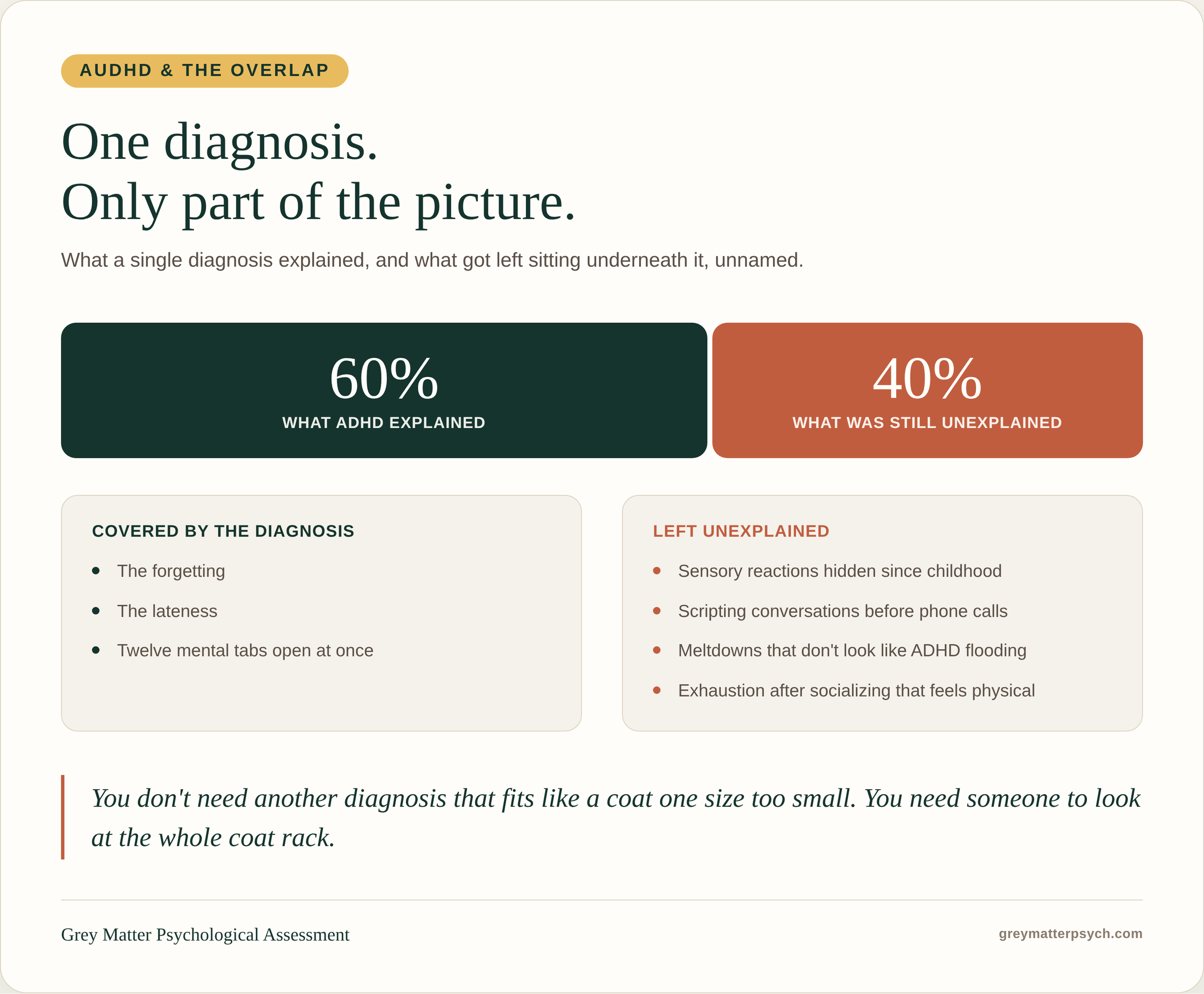
Then, finally, ADHD. And for a minute, that one felt like it landed. Somebody finally explained the forgetting, the lateness, the twelve tabs open in your brain at all times.
Except it didn't explain everything. It explained maybe sixty percent. The other forty percent just sat there. The exhaustion after socializing that felt physical. The sensory reactions you'd been hiding since you were seven. The scripts you run before phone calls. The meltdowns that don't look like ADHD emotional flooding, they look like something else entirely, and nobody had asked about them because nobody was looking for them.
I see this pattern constantly. Not because clinicians are careless. Because most evaluations are built to test for one thing at a time, and once you land on a diagnosis that explains some of it, the search usually stops. Nobody circles back to ask what's still unexplained.
Here's the thing about a diagnosis that only explains part of your life
It doesn't just fail to help with the other part. It actively gets in the way. You keep trying strategies built for the diagnosis you have on paper, and they keep half-working, or working for two weeks and then falling apart, and you start to wonder if the problem is you. If you're just bad at this. If everyone else got a version of ADHD, or anxiety, or whatever your paperwork says, that responds to treatment, and yours is defective somehow.
It's not defective. It's incomplete.
What actually happens when the whole picture gets tested at once
When we do a comprehensive evaluation, we're not trying to confirm the diagnosis you walked in with and send you on your way. We're looking at the full pattern: what fits, what doesn't, what's been sitting unexplained under a label that only ever covered part of it. Sometimes that means autism was there the whole time, underneath an ADHD diagnosis that wasn't wrong, just incomplete. Sometimes it means the anxiety was real, but it was a symptom of something else, not the root cause everyone treated it as.
Clients describe this moment the same way, over and over. Not relief that they have a new label to carry. Relief that the label finally covers all of it. That the forty percent that never made sense has a name now too.
You don't need another diagnosis that fits like a coat one size too small. You need someone to look at the whole coat rack.
Frequently Asked Questions
Why did I get diagnosed with anxiety or depression before anyone considered autism or ADHD?
Anxiety and depression are often the visible surface symptoms of an undiagnosed autism or ADHD experience, especially in people who've learned to mask well. Clinicians treating the surface symptom without looking underneath it is one of the most common reasons the full picture gets missed for years.
I already have an ADHD or autism diagnosis. Why would I get evaluated again?
Because a diagnosis that explains part of your experience isn't the same as one that explains all of it. If strategies built around your existing diagnosis keep half-working, a comprehensive evaluation can identify what else has been sitting unaddressed.
Can you have more than one diagnosis at once?
Yes, and it's common. Autism, ADHD, anxiety, and learning differences frequently co-occur, and a thorough evaluation is built to identify all of what's present, not stop at the first explanation that fits.
How is a comprehensive evaluation different from what I've already had?
Many prior evaluations, especially brief ones, screen for a single condition based on the initial referral question. A comprehensive evaluation looks at the full clinical picture from the start, so nothing gets missed because nobody was looking for it.
What if testing confirms my current diagnosis and finds nothing new?
That's a useful outcome too. Confirming that your current diagnosis is accurate and complete gives you confidence in your treatment plan instead of a lingering sense that something's still unexplained.